Context
A growing agency delivering DFY Ads and Webinar services needed a ClickUp system that could scale with its client base and team structure. Their challenge was not a lack of tools, but a lack of clarity: who owned what, where work lived, and how leadership could track progress without disrupting execution.
I designed a ClickUp demo that reflected a real production environment and could be confidently rolled out with minimal rework. See also ongoing ClickUp workflow management
Workflow Optimisation Case Study: The Client Delivery Challenge
Why Existing Project Delivery Systems Were Breaking Down
The agency faced several structural challenges common in service businesses:
- Client delivery spanned both Initial Campaign builds and ongoing Post-Launch Requests
- Work flowed across Copy, Creative, Development/GHL, and Media Buying teams
- General Managers needed high-level oversight without wading through task-level noise
- A single-list approach risked status overload and reliance on manual filtering
- A heavily segmented approach risked unnecessary complexity
The system needed to be simple to use day-to-day, but robust enough to scale.
ClickUp Workflow Design Approach
Defining a Single Source of Truth in ClickUp
I designed a hybrid ClickUp architecture that clearly separated tracking from execution:
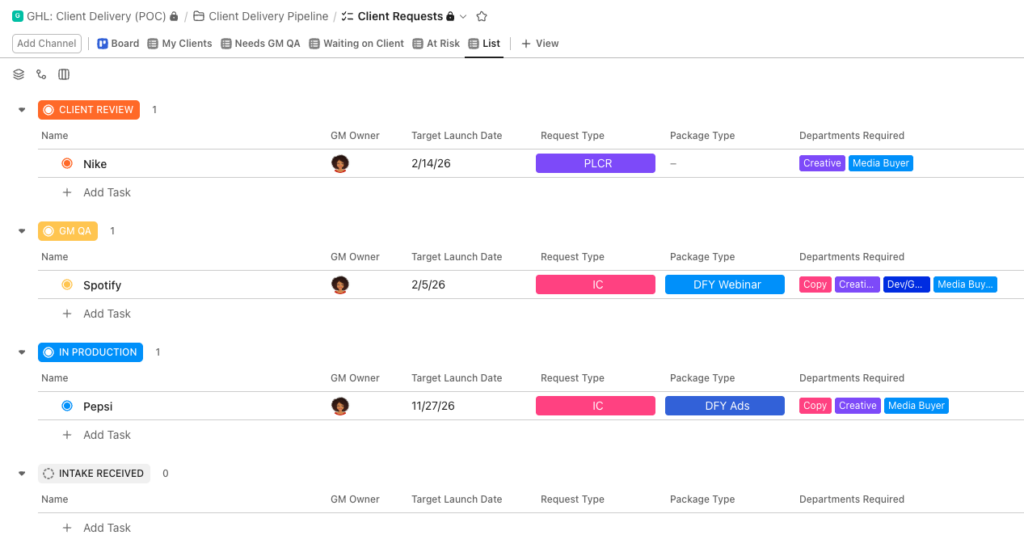
- A single Client Requests lifecycle served as the source of truth for all client work
- Custom fields distinguished IC vs PLCR requests and service packages
- Department-specific production lists allowed teams to focus only on relevant tasks
- Relationship fields linked execution work back to the client request for full traceability
- GMs operated at the request level, not inside production queues
This structure reduced noise, preserved clarity, and supported future growth without over-engineering.
How the Project Delivery System Was Structured
Balancing Simplicity and Scale in Project Delivery
- A unified client delivery pipeline with a clean, shared lifecycle
- Production queues for Copy, Creative, Dev/GHL, and Media Buying
- Clear handoff points for GM QA and client approvals
- Role-specific views for GMs and leadership
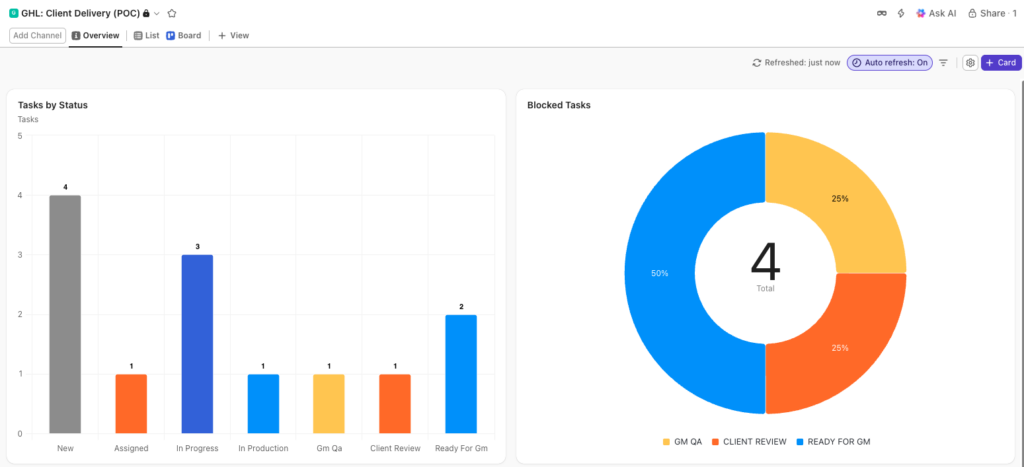
- Dashboards providing real-time visibility into delivery status, risks, and workload
The system was designed to be permission-ready, contractor-friendly, and reporting-safe.
Results: A Scalable ClickUp Workflow Design
Improved Delivery Visibility Through ClickUp Workflow Design
The final ClickUp demo demonstrated how the agency could:
- Maintain a single source of truth for client delivery
- Protect execution teams from unnecessary context switching
- Give leadership confidence through visibility, not micromanagement
- Scale services, teams, and workflows without re-architecting the system
Although delivered as a demo build, the workspace was production-ready and could be activated immediately.